The Senior Care Policy Briefing covers important long-term care issues by highlighting policy updates, news reports, and academic research.
Read the full Senior Care Policy Briefing below or download here.
June 30, 2026.
NEWSFLASH
- A new HHS Office of Inspector General (OIG) audit found that CMS’s processes were not effective in ensuring the accuracy of nursing home staffing data reported through the Payroll-Based Journal, the system used to track staffing levels and inform five-star ratings. Auditors found unsupported registered nurse staffing hours in nearly half of the sampled records and estimated that nursing homes reported approximately 938,000 RN hours that were not supported by payroll or other required documentation in a single month in 2024.
- The audit also found that CMS failed to ensure facilities corrected previously identified reporting problems and did not effectively communicate recurring audit findings to nursing homes. OIG concluded that these weaknesses may leave CMS, consumers, and policymakers relying on inaccurate staffing information when assessing nursing home performance.
NURSING HOMES WANT TOUGHER ENFORCEMENT – BUT NOT FOR THEMSELVES
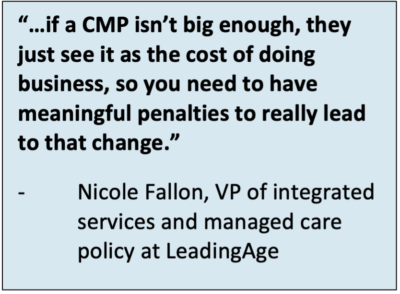
- Following a new OIG report documenting inappropriate Medicare Advantage (MA) denials of nursing home care, nursing home industry representatives are calling for stronger enforcement and more substantial penalties against insurers. Industry advocates argued that insurers will continue to deny medically necessary care unless regulators impose “meaningful penalties” that go beyond what companies view as a routine cost of doing business.
- According to one industry representative, current civil money penalties often fail to change behavior because large insurers simply absorb them as an operating expense.
- The industry’s call for stronger penalties against MA plans mirrors arguments long made by resident advocates regarding nursing homes themselves. Research has repeatedly found that nursing home penalties are often too small and infrequently applied to deter poor care, yet the industry has vigorously opposed stronger enforcement measures, safe staffing standards, and accountability requirements for nursing home operators.
MORE CONCERNS SURFACE AT ENSIGN FACILITIES
- A follow-up story by Hunterbrook reports that caregivers, former employees, and residents from Ensign-affiliated nursing homes came forward after the publication of its initial report, alleging resident hunger, understaffing, payroll falsification, and staffing-related compliance problems at facilities in multiple states.
- According to the investigation, several sources described reduced food budgets, inadequate meal portions, and chronic staffing shortages that they said affected residents’ quality of life and care.
- The report also notes that Ensign has not publicly responded to the allegations, while continuing to emphasize its financial performance and shareholder returns.