
Why This Matters
A recent McKnight’s Long-Term Care News article highlighted a Pennsylvania nursing home reportedly performing its first onsite bronchoscopy — a procedure typically associated with hospitals and specialty medical centers. The article presented the procedure as part of an emerging trend toward providing increasingly sophisticated medical services inside nursing homes in an effort to reduce hospitalizations.
This development raises important questions about resident safety and oversight.
Reducing unnecessary hospital visits can certainly benefit nursing home residents. Hospitalizations can be traumatic and dangerous for frail older adults, putting residents at risk for infections, delirium, falls, and functional decline. However, far too many nursing homes fail to provide safe, appropriate routine care. Expanding complex medical procedures into facilities with quality problems or low staffing could place residents at even greater risk by adding clinical demands to operations that are already struggling to safely meet residents’ basic care needs.
Advanced Clinical Services in a Nursing Home Struggling to Provide Basic Care
The Pennsylvania facility highlighted in the McKnight’s article holds the lowest possible overall rating on Medicare’s Care Compare website.[1] Its most recent health inspection included an Immediate Jeopardy citation — the most serious level of nursing home noncompliance, indicating that residents were placed at risk of serious harm or death.
In addition, according to the facility’s latest Payroll-Based Journal staffing submission (2025 Q4), the nursing home reported:
- Zero hours of medical director time for the entire quarter,
- Registered Nurse (RN) staffing 74% lower than expected based on resident care needs,[2]
- Nurse aide (CNA) staffing 35% lower than expected based on resident care needs, and
- Contract staffing use almost three times the national average (14% vs 5%).
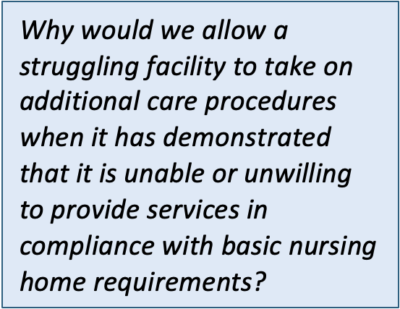
“Every public indicator reveals a nursing home that is challenged to meet the basic needs of its residents and comply with longstanding minimum standards for nursing home care,” said Richard Mollot, LTCCC’s Executive Director. “Why would we allow a struggling facility to take on additional care procedures when it has demonstrated that it is unable or unwilling to provide services in compliance with basic nursing home requirements?”
The Push Toward Higher-Acuity Care Among Operators with Quality and Staffing Concerns
These concerns are particularly troubling given the growing push toward higher-acuity care inside nursing homes. In recent years, industry publications have increasingly highlighted facilities providing onsite dialysis, blood transfusions, intravenous therapies, ventilator services, and other advanced clinical interventions traditionally associated with hospitals or specialty centers.
For example, in 2024 McKnight’s reported on New York nursing homes receiving approval to conduct onsite blood transfusions in an effort to reduce hospitalizations. Another McKnight’s article highlighted a Texas nursing home operator launching onsite transfusion services across its facilities. Skilled Nursing News has also reported on the expansion of onsite dialysis programs in nursing homes as providers pursue higher-acuity and value-based care financial models.
The New York operator, The McGuire Group, owns six nursing homes. Current federal data (May 2026) indicate that they have:
- Slightly above average inspection ratings and slightly below average staffing ratings,
- Overall nurse staffing 25% below expected staffing levels based on resident care needs, and
- Registered nurse staffing 56% below expected staffing levels based on resident care needs.
The Texas operator, Cantex Continuing Care, owns 38 nursing homes (Texas and Louisiana). Current federal data (May 2026) indicate that they have:
- Below average ratings for both health inspections and staffing,
- Overall nurse staffing 33% below expected staffing levels based on resident care needs, and
- Registered nurse staffing 55% below expected staffing levels based on resident care needs.
While some facilities may possess the staffing, infrastructure, oversight, and clinical partnerships necessary to safely provide these services, many clearly do not. Across the country, nursing homes continue to receive serious citations for failures involving infection control, medication administration, resident supervision, abuse prevention, emergency response, and basic care practices. Inadequate staffing to meet basic needs is a widespread and pervasive problem. According to CMS’s latest report on nurse staffing (2025 Q4), close to 9 in 10 nursing homes fall below their expected staffing levels, with the average facility under-staffed by 24% on a daily basis. As LTCCC has previously noted, Immediate Jeopardy citations have resurged in the post-pandemic period.
Research Underscores the Need for Caution
Research on advanced clinical services in nursing homes suggests that some higher-acuity care may help reduce avoidable hospital transfers and improve continuity of care when adequate staffing, clinical oversight, and infrastructure are in place. At the same time, the available literature also emphasizes that residents receiving these services are medically complex and clinically vulnerable, often requiring intensive monitoring, rapid response capacity, strong infection prevention practices, and close coordination among providers. Studies examining dialysis, intravenous therapy, and post-acute antibiotic treatment in nursing homes have identified both potential benefits and significant operational challenges.[3]
These findings are particularly concerning in light of the longstanding quality and staffing problems that persist throughout much of the nursing home industry. Surveyors continue to cite facilities nationwide for serious deficiencies involving infection control failures, medication errors, neglect, inadequate supervision, and insufficient staffing. Yet oversight mechanisms remain limited, inconsistent, and largely reactive. Expanding hospital-level procedures into facilities that frequently fail to meet basic standards of care raises serious concerns about resident safety, accountability, and the stewardship of services that are largely taxpayer funded. It also raises serious questions about whether the current regulatory system — which has struggled for decades to effectively address substandard care, chronic understaffing, and fraud — is equipped to ensure that increasingly complex clinical services can be provided safely and appropriately.
Recommendations for Policymakers and Oversight Agencies
Given the growing interest among some nursing homes in providing higher-acuity clinical services, policymakers and oversight agencies should consider:
- Requiring enhanced review and approval before nursing homes are permitted to provide advanced clinical procedures traditionally associated with hospitals or specialty centers;
- Evaluating whether facilities seeking to provide such services have sufficient RN staffing, physician oversight, infection prevention capacity, emergency response systems, and demonstrated records of regulatory compliance;
- Requiring greater public transparency regarding specialized services offered by nursing homes, including clinical oversight arrangements, adverse events, and hospitalization outcomes;
- Conducting targeted oversight and audits of facilities providing advanced clinical services, particularly when facilities with histories of serious deficiencies, chronic understaffing, or poor inspection performance are permitted to provide these services;
- Examining whether existing federal and state oversight systems are adequately equipped to monitor increasingly complex medical care in nursing home settings;
- Reviewing whether additional legal safeguards, standards, reporting requirements, or enforcement mechanisms are necessary to protect resident safety as nursing homes expand into higher-acuity services.
Recommendations for Consumers and Advocates
Consumers, family members, and advocates should proceed cautiously when considering nursing homes that advertise specialized or hospital-level services, particularly for residents with medically complex needs such as dialysis, respiratory therapy, intravenous medications, ventilator care, or other advanced clinical interventions.
Before selecting a facility for higher-acuity care, consumers and advocates should carefully review publicly available information regarding the nursing home’s staffing levels, inspection history, and clinical oversight. Important considerations include:
- Whether the facility’s nurse staffing levels — particularly Registered Nurse (RN) staffing — meet or exceed expected staffing levels for resident care needs, as identified in CMS Payroll-Based Journal data and LTCCC’s quarterly staffing reports;
- Whether the facility has a designated and active medical director providing clinical oversight and leadership;[4]
- Whether the facility has strong health inspection ratings. Facilities with health inspection ratings below four stars warrant additional scrutiny, particularly if they are advertising advanced or hospital-level clinical services; and
- Whether the facility relies heavily on contract staff or has high staff turnover rates, which can affect continuity and quality of care.[5]
[1] Care Compare listing accessed May 26, 2026. The Care Compare listing also had a red warning icon, indicating that this facility has been cited for abuse.
[2] Expected staffing levels referenced here and elsewhere in this policy brief are based on a case-mix adjusted staffing methodology which uses CMS resident acuity data and evidence-based staffing research to estimate the nursing staffing hours needed to meet residents’ care needs. For methodology, see LTCCC’s “Summary of Methodology for Calculating Expected Nurse Staffing” and Harrington et al., “Nursing Home Guide to Adjusting Nurse Staffing for Resident Case-Mix,” Journal of the American Geriatrics Society (2025). https://nursinghome411.org/nurse-rating-methodology/ https://doi.org/10.1111/jgs.19501
[3] See, e.g., Bellin et al., “Epidemiology of Nursing Home Dialysis Patients — A Hidden Population,” Hemodialysis International (2021), https://pmc.ncbi.nlm.nih.gov/articles/PMC8596662/; Hall et al., “End-Stage Renal Disease in Nursing Homes: A Systematic Review,” JAMDA (2013), https://pubmed.ncbi.nlm.nih.gov/23375523/; McArthur et al., “Building Capacity in Long-Term Care: Supporting Homes to Provide Intravenous Therapy,” Canadian Geriatrics Journal (2018), https://pmc.ncbi.nlm.nih.gov/articles/PMC6281378/; Osakwe, “Transitioning Antibiotics from Hospitals to Nursing Homes: Bridging the Gap,” JAMDA (2023), https://www.jamda.com/article/S1525-8610(23)00410-3/fulltext; Travers et al., “Strategies to Improve Emergency Transitions From Long-Term Care Facilities: A Scoping Review,” The Gerontologist (2024), https://academic.oup.com/gerontologist/article/64/7/gnae036/7658179.
[4] See LTCCC’s quarterly non-nursing staffing reports for information on medical director presence. https://nursinghome411.org/data/staffing/
[5] See LTCCC’s quarterly nurse staffing reports for information on the use of contract staff and LTCCC’s provider data reports for nurse turnover rates. https://nursinghome411.org/data/staffing/ https://nursinghome411.org/data/ratings-info/