

The Senior Care Policy Briefing covers important long-term care issues by highlighting policy updates, news reports, and academic research.
Read the full Senior Care Policy Briefing below or download here.
June 1, 2026.
NEWSFLASH
- Senate Democrats are calling for new federal policies to improve nursing home care quality and access, arguing that longstanding staffing shortages, ownership complexity, and uneven oversight continue to put residents at risk. Lawmakers highlighted the need for stronger accountability measures, increased transparency, and policies that ensure public funding is directed toward resident care rather than excessive profits or complex financial arrangements.
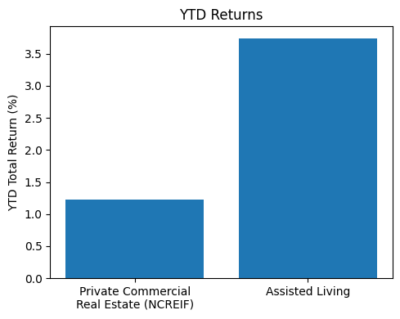
- New reports from the National Investment Center (NIC) and McKnight’s Senior Living show that senior living investment performance in the first quarter was the strongest in nearly a decade, reflecting rising occupancy, improving operating margins, and strong investor confidence in the sector. Notably, NIC reported that year-to-date (YTD) returns for assisted living were roughly three times higher than returns for private commercial real estate properties tracked by the NCREIF Property Index (NPI), underscoring the sector’s growing profitability.
- The strong financial performance of assisted living operators and investors comes as the industry continues to fight any federal safety requirements or standards. Such requirements are needed now more than ever as assisted living facilities are taking in – and retaining – people with higher needs.
RESEARCH SPOTLIGHT
- A new study finds that Medicare Advantage patients hospitalized for strokes or hip fractures are more likely to be discharged home rather than to skilled nursing facilities, compared with patients in traditional Medicare. Researchers suggest the trend may reflect efforts to reduce post-acute care spending and manage utilization within Medicare Advantage plans.
- The findings raise concerns about whether patients are receiving appropriate rehabilitation and post-acute support following serious medical events.
- New research published in JAMDA finds that nursing homes located in more socioeconomically disadvantaged neighborhoods have significantly lower registered nurse staffing levels, highlighting how community-level inequities can affect care quality. Researchers found that facilities in low-income areas consistently had fewer registered nurse and total nursing staff hours per resident day, including on weekends. The study warns that these disparities may compound existing barriers to quality care in already under-resourced communities.
- Researchers note that registered nurses play a central role in clinical oversight, care coordination, and maintaining quality standards, making shortages especially concerning. The study also found that for-profit facilities, chain-affiliated facilities, and nursing homes with higher Medicaid populations tended to have lower staffing levels.