
The Senior Care Policy Briefing covers important long-term care issues by highlighting policy updates, news reports, and academic research.
Read the full Senior Care Policy Briefing below or download here.
October 31, 2025.
NEWSFLASH
- Due to the ongoing federal government shutdown, most routine nursing home inspections have been temporarily halted, including annual surveys and non-urgent complaint reviews. The only exceptions are for “credible allegations of immediate jeopardy… or harm to an individual.”
- This pause puts residents at serious risk of abuse and neglect, and will add to the already significant backlog of long-term care facility inspections once funding resumes.
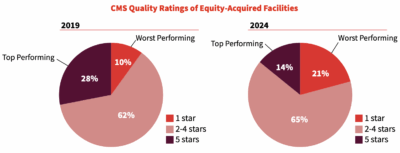
- A new AARP Florida report, “Change of Ownership and Quality in Florida Nursing Homes,” finds that more than one-third of Florida nursing homes have changed ownership since 2019, many purchased by private-equity or investor-owned groups. These facilities showed consistent declines in quality ratings, staffing hours, and administrative stability following acquisition.
- The report highlights that complex, opaque ownership structures often obscure accountability and may divert funds away from resident care.
- AARP Florida urges stronger transparency, oversight, and consumer-notification policies to ensure that ownership changes do not compromise care quality or resident safety.
- A new report from the National Consumer Voice, “Where Does All the Money Go?” reveals that many for-profit nursing homes chains divert millions of taxpayer dollars to companies they own or control, rather than investing in resident care. From 2021 to 2023, three major chains operating 32 homes in New Jersey paid roughly $206 million to affiliated companies, while staffing levels at these homes averaged only 3.26 nursing hours per resident per day, well below the state average of 3.83 and far lower than nonprofit homes (4.67 HPRD).
RESEARCH ROUNDUP
- A new study published in Health Affairs finds that private equity-owned hospices earn the highest profits but spend the least on direct patient care compared with other ownership types. Using 2022 Medicare cost data, the researchers report that not-for-profit hospices devote substantially more resources to nursing and bedside care, while private equity-owned agencies focus on efficiency and nursing-facility-based services.
- Nearly two-thirds of U.S. nursing home residents were exposed to potentially harmful drug combinations between 2018 and 2020 according to a new study published in the Journal of the American Geriatrics Society. The research highlights widespread risks from polypharmacy in long-term care, where older adults often take multiple medications that can interact dangerously, according to McKnight’s. These drug-drug interactions have been linked to adverse drug effects, and increased morbidity and mortality.