The Senior Care Policy Briefing covers important long-term care issues by highlighting policy updates, news reports, and academic research.
Read the full Senior Care Policy Briefing below or download here.
July 15, 2026.
NEWSFLASH
- The NY State Department of Health has proposed reducing the state’s certified nurse aide (CNA) training requirement from 100 hours to the 75-hour federal minimum – a 25% reduction in training for the frontline caregivers who provide most hands-on nursing home care. LTCCC is urging the Department to withdraw the proposal, arguing that it lacks an evidence-based rationale and moves in the opposite direction of expert recommendations and research showing that more training improves care and provides for a better, more stable work environment.
- The majority of states require more training than the federal minimum. If “successful,” this would be the first time (to our knowledge) that a state has rolled back minimum training requirements.
- Today’s nursing home residents have far greater medical, behavioral, and dementia care needs than they did when the federal 75-hour minimum was established nearly four decades ago. Reducing training requirements risks leaving caregivers less prepared to meet residents’ needs while undermining quality of care, resident safety, and the preparedness of the frontline workforce.
OVERSIGHT AND ACCOUNTABILITY
- The Office of Inspector General’s Spring 2026 Semiannual Report to Congress highlights nursing homes as one of OIG’s continuing enforcement priorities, citing recent work on inappropriate antipsychotic drug use, inaccurate staffing data, Medicare Advantage denials of skilled nursing care, improper schizophrenia diagnoses, and pandemic preparedness. Together, the report reinforces OIG’s longstanding conclusion that protecting nursing home residents requires stronger oversight, accurate staffing information, and greater accountability.
- Massachusetts Attorney General Campbell has secured a $27.5 million settlement with a nursing home ownership group to resolve allegations that it systematically understaffed multiple facilities, resulting in resident neglect and substandard care. According to AG Campbell, the companies prioritized profits over resident care by failing to provide sufficient staffing to meet residents’ basic needs, leading to inadequate hygiene, untreated medical conditions, falls, pressure ulcers, malnutrition, and other serious harms.
RESEARCH SPOTLIGHT
- A new NBER working paper by Ashvin Gandhi, Andrew Olenski, and Maggie Shi finds that nursing homes strategically increase staffing and other aspects of care as annual inspections approach, then scale back those efforts after inspections are completed. Because inspections generally occur on a predictable annual schedule, facilities are able to anticipate when surveyors are most likely to arrive.
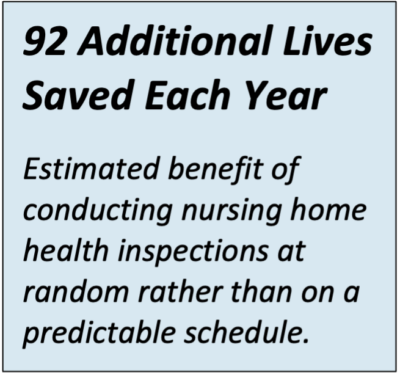
- The researchers conclude that making inspections less predictable could improve care throughout the year. Their analysis estimates that randomizing inspection timing would save approximately 92 additional lives annually – an improvement comparable to increasing inspection frequency by 10 percent.
- Note: Federal rules for state survey agencies require that surveys are unannounced and their timing unpredictable. For more information, see LTCCC’s Guide to Nursing Home Oversight & Enforcement.