

The Senior Care Policy Briefing covers important long-term care issues by highlighting policy updates, news reports, and academic research.
Read the full Senior Care Policy Briefing below or download here.
January 30, 2026.
NEWSFLASH
- The Federal Housing Administration closed a landmark year with $8.1 billion in firm commitments and more than $6 billion in insured mortgages for senior living and care facilities, reflecting strong federal backing for sector financing.
- LTCCC has long been concerned that favorable government financing extended to the senior care industry lacks meaningful safeguards to ensure recipients are operating in compliance with minimum standards of care. Absent such accountability, taxpayers are effectively rewarding providers who, too often, fail their residents and misuse the public funds that underwrite most nursing home care.
INVESTOR ACTIVITY AMID CALLS FOR PAYMENT CUTS
- A bankruptcy judge approved the sale of Genesis HealthCare’s assets to bidder 101 West Street, even as court proceedings raised serious concerns about the buyers and financing behind the deal. Testimony revealed that the purchasers may rely on a $35 million loan from an operator currently facing state-led nursing home fraud cases, and that one of the buyer’s affiliated ventures owns facilities averaging just over two stars for quality.
- The scramble among multiple investors to acquire a bankrupt nursing home chain underscores a stark contradiction: despite industry claims of razor-thin margins, distressed nursing home assets continue to attract aggressive and well-financed bidders.
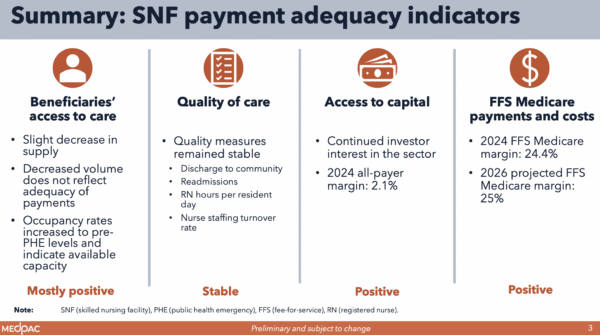
- In its January 2026 report, MedPAC recommended a 4% cut to Medicare SNF payments, pointing to indicators shown in the accompanying graphic, including increased occupancy, continued investor interest, and strong fee-for-service Medicare margins. The graphic highlights MedPAC’s conclusion that payment adequacy is mostly positive, even as supply has slightly declined and facilities report adequate capacity.
BURNOUT ON THE FRONT LINES
- Healthcare and other frontline workers, including those in senior living and long-term care, report significantly lower job satisfaction than office-based workers, according to new survey data cited by McKnight’s. The findings highlight persistent challenges such as understaffing, high workloads, and limited flexibility, at a time when CMS is repealing the federal minimum staffing rule designed to reduce workload pressures and improve retention.
- Nearly half of nurses report feeling unsafe at work, according to a new national survey of nursing students and early-career nurses, McKnight’s reports. Respondents cited concerns including workplace violence, inadequate staffing, and lack of institutional support – factors that contribute to burnout and drive nurses away from bedside roles.