
The Senior Care Policy Briefing covers important long-term care issues by highlighting policy updates, news reports, and academic research.
Read the full Senior Care Policy Briefing below or download here.
February 17, 2026.
NEWSFLASH
- New New York Times reporting details how nursing home executives donated nearly $4.8 million to a pro-Trump super PAC shortly before securing a private meeting with President Trump, where they personally urged repeal of the federal minimum staffing rule. Within weeks, the administration stopped defending the rule in court and, months later, approved a full revocation, parroting industry arguments about cost and workforce challenges. The investigation highlights the unusual degree of donor access and influence granted to nursing home executives, even as research suggests the rule could have saved thousands of lives each year.
- LTCCC submitted comments strongly opposing the repeal of the staffing rule, emphasizing that chronic understaffing is a long-documented, systemic failure – not an unavoidable workforce challenge – that places residents at risk of neglect and harm. Drawing on decades of research and federal data, LTCCC urged CMS to rescind the repeal and uphold its obligation under the Nursing Home Reform Law to ensure safe and dignified care. Read our comments here.
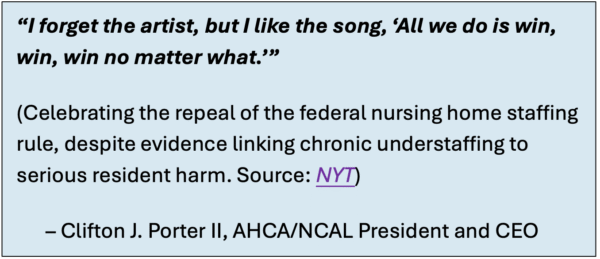
- American Health Care Association (AHCA)/National Center for Assisted Living (NCAL) President and CEO Clifton J. Porter II, head of the nation’s largest nursing home and assisted living trade association, was named one of The Hill’s Top Lobbyists of 2025 and one of Modern Healthcare’s “The 100 Most Influential People in Healthcare,” recognized in part for his role in defeating the federal minimum staffing mandate and advancing the industry’s policy agenda.
- Why it matters: This award underscores the political influence nursing home industry leadership wields in Washington, resulting in “achievements” that have direct negative consequences for resident safety, working conditions, and the integrity of the use of taxpayer funds.
“RATIONALIZING” REGULATION – OR ROLLING BACK ACCOUNTABILITY?
- Industry groups are lobbying for the “rationalization” of nursing home regulations, claiming that longstanding minimum health standards are too burdensome. AHCA’s proposal includes reducing the frequency of inspections, giving the industry easier access to bonus funding, and tailoring the Special Focus Facility Program — created to force the nation’s very worst facilities to do better or get out of the business — so that it shifts from enforcing accountability to providing free assistance for repeat offenders.
- Reality Check: Proposals to “streamline” oversight would almost certainly accelerate the normalization of substandard care and create new incentives for predatory investors to enter the nursing home industry. Reducing inspections, weakening enforcement tools, or prioritizing operator convenience over resident safety shifts risk away from providers and onto residents. In practice, weak oversight has repeatedly allowed facilities with documented patterns of neglect to continue operating with little consequence. At a time when evidence of harm is widespread and well-documented, weakening regulatory safeguards threatens to further erode accountability and deepen the crisis facing nursing home residents and workers.