The Senior Care Policy Briefing covers important long-term care issues by highlighting policy updates, news reports, and academic research.
Read the full Senior Care Policy Briefing below or download here.
April 30, 2026.
NEWSFLASH
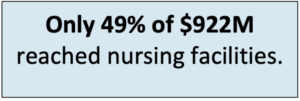
- A Utah State Auditor report found significant oversight failures in a Medicaid supplemental payment program for nursing homes, with large portions of funding not reaching facility-level care. Auditors determined that only about 49% of $922 million in program funds were ultimately used at nursing facilities, with the remainder retained by affiliated entities or used for other purposes.
- The audit also found that “seed money” used to draw down federal funds was never actually used for nursing home care, and that administrative fees collected exceeded the state’s estimated costs.
- Overall, the report raises concerns that weak oversight and unclear rules allowed substantial public funds intended for resident care to be diverted or used inconsistently with program goals.
- A Kentucky state audit found years of missed nursing home inspections and failures in Medicaid eligibility oversight, raising serious concerns about gaps in regulatory enforcement and program integrity. Investigators identified lapses in required survey timelines and weaknesses in monitoring eligibility determinations, potentially exposing residents to risk and allowing improper payments to continue. The findings highlight significant breakdowns in basic oversight functions.
- Missed inspections and eligibility failures underscore a longstanding national problem: without consistent enforcement and adequate oversight capacity, even well-established standards and safeguards cannot protect residents or ensure responsible use of public funds.
UNSAFE STAFFING, UNSAFE CARE
- McKnight’s Senior Living reports that “the most serious nonfatal workplace accidents cost healthcare companies more than $6.9 billion per year in medical and lost wage payments.” The author adds that “overworked or inexperienced staff members are more likely to make errors that harm residents,” leading to increased liability and malpractice costs.
- These findings highlight how staffing shortages and high turnover create risks not only for workers but also for residents – underscoring that safe staffing levels are essential to both worker safety and quality of care.
TOO MANY MEDS, TOO MUCH RISK
- A new study finds that psychotropic polypharmacy – using multiple psychotropic medications at once – is common among older adults with Parkinson’s disease and is associated with significantly increased risks of falls and fractures. While prior research has documented risks from individual medications, this study adds evidence on the compounded dangers of combining these drugs in already high-risk populations. The findings underscore the need for greater caution in prescribing and closer monitoring of medication use.
- By highlighting the risks of multiple concurrent medications, the study reinforces concerns that complex drug regimens – often used in place of adequate staffing and individualized care – can expose vulnerable residents to preventable harm.