The Senior Care Policy Briefing covers important long-term care issues by highlighting policy updates, news reports, and academic research.
Read the full Senior Care Policy Briefing below or download here.
September 18, 2026.
NEWSFLASH
- Nursing home inspections in New Jersey are falling significantly behind federal requirements. Federal policy requires every nursing home to receive a standard survey at least once every 15 months, with a statewide average of no more than 12 months. But a recent state audit found that, as of February 2026, New Jersey was conducting surveys every 20 months on average, and more than a quarter of the state’s nursing homes had gone at least two years without a standard survey.
- Timely surveys are fundamental to nursing home oversight. When inspections are delayed for months – or even years – serious deficiencies may go unidentified and uncorrected, leaving residents at risk.
- The New Jersey findings come as CMS begins nationwide implementation of its new Risk-Based Survey (RBS) process. Under RBS, so-called “low-risk” nursing homes – about 12% of all facilities – receive shorter surveys using far fewer surveyors. Key issues like dining, resident abuse, and neglect are no longer mandatory areas of the inspection. CMS says the change will allow states to direct limited survey resources toward facilities where residents’ health and safety are at greater risk.
- LTCCC’s alert called on CMS to use readily available data to make surveys more effective and efficient, rather than putting residents in these facilities at risk. Our Guide for LTC Ombudsmen provides user-friendly information and tips for providing valuable input on the RBS.
STANDARDS WITHOUT ENFORCEMENT
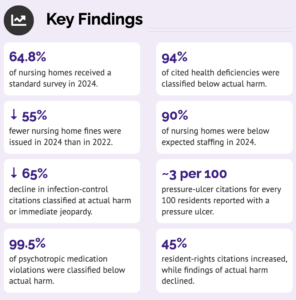
- A new LTCCC study finds significant gaps in nursing home oversight and enforcement. The Accountability Gap: Nursing Home Oversight & Enforcement in the United States examines federal data on surveys, deficiencies, enforcement, staffing, and key resident care indicators to assess whether the oversight system is effectively identifying and responding to poor care.
- Federal standards only protect residents when violations are identified and meaningfully enforced. LTCCC’s findings raise serious concerns about an accountability gap between the protections residents are promised and the care they actually receive.
ENFORCEMENT IN ACTION
- Three New York nursing homes have agreed to pay $9 million to resolve federal and state allegations involving fraudulent Medicare and Medicaid billing. Authorities allege that the Safire homes manipulated rehabilitation services and documentation to increase reimbursement, including providing or scheduling therapy based on reimbursement policies rather than residents’ medical needs.
- The case demonstrates the importance of meaningful enforcement and accountability when public reimbursement and resident care become misaligned.