The Senior Care Policy Briefing covers important long-term care issues by highlighting policy updates, news reports, and academic research.
Read the full Senior Care Policy Briefing below or download here.
November 19, 2026.
NEWSFLASH: NURSING HOME PRICES CONTINUE TO CLIMB
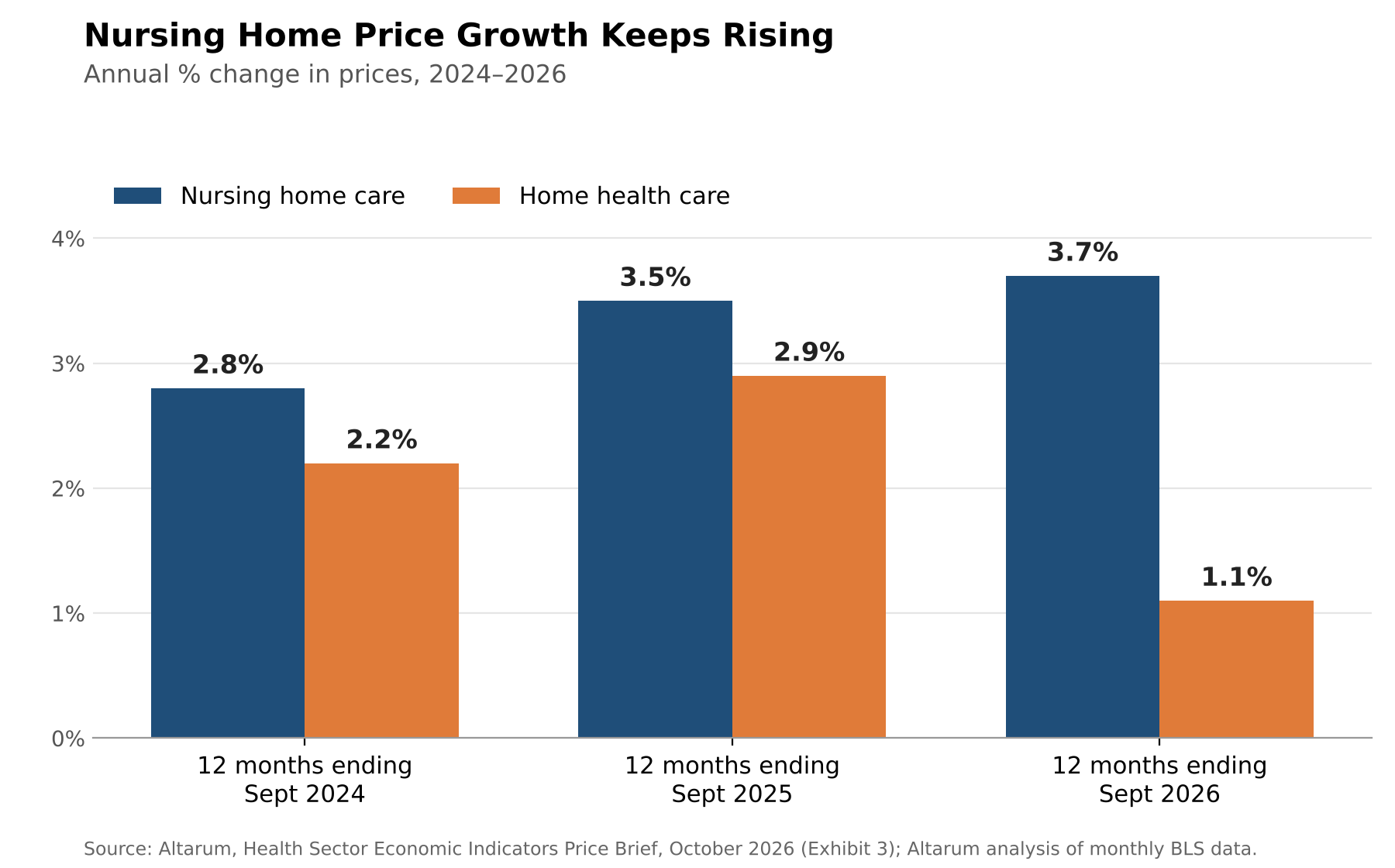
- Nursing home prices increased 3.7% over the 12 months ending September 2026, up from 3.5% in 2025 and 2.8% in 2024, according to Altarum’s October 2026 Health Sector Economic Indicators report.
- By comparison, home health care prices increased just 1.1% over the latest 12-month period.
- Rising prices ≠ better care. As nursing home costs increase, residents, families, and taxpayers deserve to know whether growing expenditures translate into sufficient staffing, meaningful services, and a better quality of life.
SENIOR HOUSING INVESTMENTS DELIVER BIG RETURNS
- The National Investment Center for Seniors Housing & Care (NIC) reports that senior housing investments generated a 6.0% total return in the third quarter of 2026, compared with 1.4% for the broader commercial property index.
- Assisted living investments generated a 6.6% quarterly return and a 19.8% return over the preceding year. Senior housing occupancy also reached 90.4% in the third quarter.
- While assisted living investors and operators are enjoying high profits, concerns are growing that – in the absence of meaningful oversight and transparency – seniors and families are, too often, financially exploited by their communities or not receiving promised care and services.
FLORIDA TAKES AIM AT MEMORY CARE OVERSIGHT
- As assisted living facilities increasingly serve people with dementia and complex care needs, Florida is taking steps to strengthen oversight. In May 2026, Florida enacted a law requiring assisted living facilities that provide or advertise memory care to obtain a special license. In October, the state’s Agency for Health Care Administration released proposed regulations establishing staffing, training, medication, and resident care standards.
- Draft regulations would establish safeguards, including:
- Staffing: At least one direct care staff member for every five memory care residents at all times.
- Medication protections: Licensed nurse administration of medications for memory care residents, subject to the proposed rule’s provisions.
- Resident-centered care: Individualized service plans, dementia-specific activities, safeguards against wandering, and non-drug approaches to residents’ behavioral expressions.
Calling a facility “memory care” should mean more than a marketing promise. Facilities serving people with dementia must have the staff, training, and safeguards necessary to meet their needs. Florida’s proposed standards are an important step, but strong final rules and effective oversight will be critical.