
The Senior Care Policy Briefing covers important long-term care issues by highlighting policy updates, news reports, and academic research.
Read the full Senior Care Policy Briefing below or download here.
March 31, 2026.
NEWSFLASH
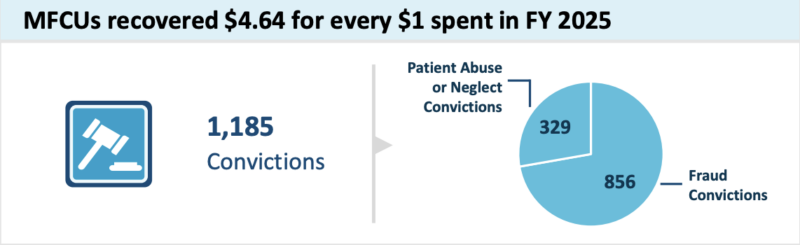
- A new HHS Office of Inspector General (OIG) report finds that Medicaid Fraud Control Units (MFCUs) recovered more than $700,000 in assisted living-related cases, while over 300 investigations remain ongoing, according to McKnight’s. The cases involve a range of issues, including improper billing and resident harm. MFCUs secured 1,185 convictions in FY 2025, including 329 cases involving patient abuse or neglect, and recovered $2 billion in total – returning $4.64 for every $1 spent.
- The volume of open investigations reinforces that fraud and abuse are not isolated incidents but part of a broader, systemic problem – particularly in assisted living settings, which lack meaningful oversight and operate with virtually no enforceable accountability.
- A new Rockefeller Institute analysis finds that civil monetary penalties (CMPs) against nursing homes are relatively small and inconsistently applied, raising concerns about their effectiveness as a deterrent to poor care. The report shows that penalties often represent only a minor financial burden for facilities – particularly larger or multi-facility operators – and may fail to meaningfully influence behavior or improve compliance. Researchers also highlight variability in enforcement and collection, suggesting that current penalty structures may not adequately hold underperforming facilities accountable.
- The findings reinforce longstanding concerns that weak financial penalties allow persistently poor-performing nursing homes to continue operating without meaningful consequences, undermining accountability and resident protections.
THE ILLUSION OF FIVE-STAR CARE
- Nursing home quality measure ratings may be artificially inflating overall star ratings, masking serious care deficiencies, the Center for Medicare Advocacy reports. The analysis highlights how self-reported data – particularly on measures tied to staffing and resident outcomes – can be manipulated or inconsistently reported, allowing facilities with poor performance in inspections or staffing to still receive relatively high overall ratings. This raises concern about the reliability of the Five-Star Quality Rating System as a tool for consumers and policymakers.
ANTIPSYCHOTICS AND STROKE DANGER
- A new population-based study finds that the antipsychotic risperidone is associated with an increased risk of stroke among people living with dementia, including those both with and without underlying cardiovascular disease. The findings reinforce longstanding concerns about the safety of antipsychotic use in this population, particularly given their widespread use in long-term care settings. Researchers emphasize the need for careful prescribing and monitoring, given the serious risks associated with these medications.