
The Senior Care Policy Briefing covers important long-term care issues by highlighting policy updates, news reports, and academic research.
Read the full Senior Care Policy Briefing below or download here.
July 31, 2026.
NEWSFLASH
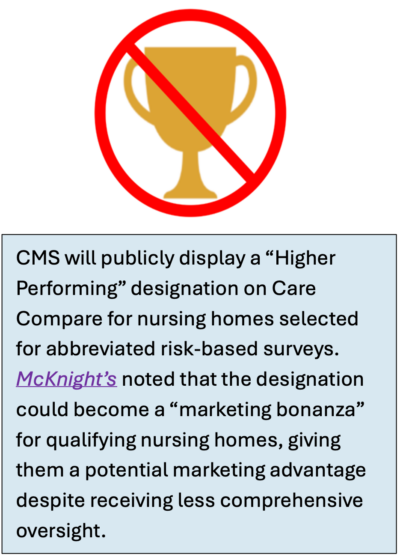
- The Centers for Medicare & Medicaid Services (CMS) has announced a new Risk-Based Survey (RBS) process for nursing homes that will take effect on September 8, 2026. Under the new approach, about 12% of nursing homes identified by CMS as “Higher Performing” will receive a modified standard survey that prioritizes selected areas of concern rather than a comprehensive review of all regulatory requirements.
-
- LTCCC is urging CMS to withdraw the policy, warning that replacing comprehensive, resident-centered inspections with a narrower, risk-based approach could allow serious problems affecting residents’ health, safety, dignity, and quality of life to go undetected. Many critical aspects of care, including abuse, neglect, psychosocial well-being, and quality of life, cannot be reliably identified through quality measures, administrative data, or other risk indicators alone and require thorough, on-site observation and resident interviews.
- The National Consumer Voice for Quality Long-Term Care and the Center for Medicare Advocacy have likewise warned that reducing oversight jeopardizes resident protections.
- Standard surveys are the foundation of nursing home oversight because they evaluate the full range of federal resident protections. Weakening these inspections risks reducing accountability at a time when persistent concerns about understaffing, inappropriate drugging, and poor quality of care continue to threaten resident well-being.
- CMS has rescinded guidance on nursing home residents’ voting rights and replaced it with a new memo. While the new memo reiterates that residents retain the legal right to vote, it puts the onus on residents to identify and ask for the help that they need, rather than making it an affirmative facility responsibility.
- LTCCC strongly condemns this action, which changes federal policy for close to 15,000 nursing homes citing just two cases of alleged fraud, both of which involved highly unusual, politicized circumstances and neither of which resulted in any substantiated case of voting irregularity.
RESEARCH SPOTLIGHT
- A new study published in the Journal of the American Medical Directors Association concludes that average nursing home staffing levels do not necessarily reflect whether residents receive adequate staffing when they need it most. The authors argue that facility-wide averages can obscure significant day-to-day and shift-to-shift staffing shortages, potentially giving an inaccurate picture of the care residents actually experience.
- Residents receive care from the staff who are present on a given shift – not from an annual or quarterly average. The findings reinforce the importance of evaluating staffing based on residents’ care needs and the consistency of staffing over time, rather than relying solely on facility-wide averages.